
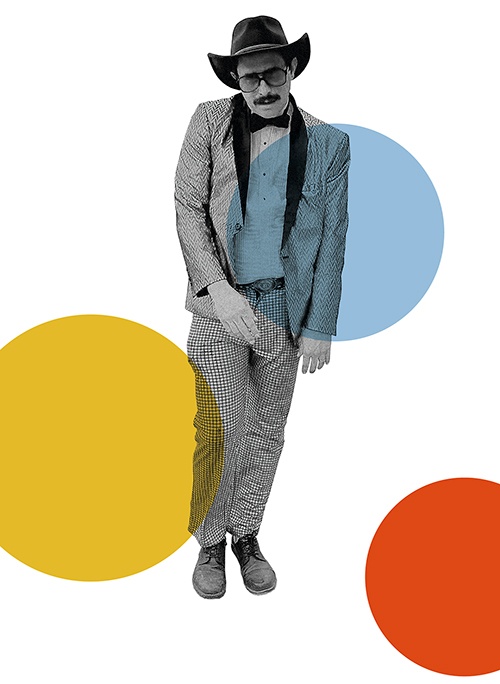
 Art by Nancy Pavan, photo courtesy of @kevingregorykrieger
Send in the Clowns
A new movement in clowning, from LA to Montreal, is ditching the red nose and offering the cutting-edge comedy we need.
My back was to the audience in a nondescript Montreal studio. Behind me, a dozen classmates—fellow initiates into the art of plain-clothes clowning—sat in dark red plastic chairs. We were attending a workshop led by Los Angeles clown Kevin Krieger (pictured), and a few feet to the left of me stood my competitor. My mission? Nothing less than to Save the Show.
The exercise was simple: each clown had a minute to make the audience laugh. It was entirely improvised, no safety net. All you could do was launch into the void and find out whether you would land or flop. There were no red noses in sight, no props to hide behind. Just an offer and sixty seconds.
I stared at the grey wall as I overheard my fellow clown do … something that got the crowd going. I couldn’t tell what the bit was, but the riotous laughter pealed through my brain. I was too in my head. My heart raced. What would I do when I got out there? Make ‘em laugh, make ‘em laugh. “Jac, you’re up.” It was time.
True to the spirit of the form, I fell into clowning ass-backwards. A year ago, seeking to expand my performance horizons but with a chronic back injury limiting my physical range, I stumbled from burlesque, to heels dance, into an introductory clown workshop. For the terminally anxious writer, you might think a clown class would be hell on earth. You would be right. Until recently, I might never have considered it.
For years, I had associated clown work with a single potent symbol: the red nose. I now know that the red nose is part of a storied tradition, considered amongst clowns the smallest mask a performer can wear, the entryway to play and conveying character. But the red nose also stands for a set of assumptions and stereotypes with which contemporary clowns must inevitably contend, as well as a complex and fraught history. For many, the art of clowning—often simply referred to as “clown”—evokes Stephen King’s white-faced, terror-inducing Pennywise, Batman’s moody, maniacal Joker or the rambunctious, makeup-clad Juggalos, fans of hip-hop group Insane Clown Posse.
Then again, I’d argue that polite, respectable society doesn’t think much about clowns at all. If anything, the exaggerated physical comedy of clown is considered an outdated kind of entertainment, perhaps associated with birthday clowns or an archetype located in the past. Growing up in the nineties, I thought clowning was archaic. The clown who epitomized the form for me was The Simpsons’ Krusty: red-nosed, washed-up, barely clinging to his former popularity for the sake of the cash. Taking one pie to the face after another as he awaited the blissful release of death. Clowns can mean many things to many people, but most people don’t think of clowns when they think of what’s at the cutting-edge of funny today. I certainly didn’t.
When the COVID-19 pandemic hit, that all changed. As Quebec’s stay-at-home order went into effect in March 2020, I holed up in my apartment, masked up outdoors, and did my virtual yoga alone (okay, with two cats). The prolonged isolation took its toll. I hadn’t performed since high school jazz band, but once the order lifted I began enrolling in performance workshops. I needed to get off the internet and into my body again.
As it turns out, I wasn’t the only one seeking a change. Members of the clown community suggest that the pandemic acted as a turning point for clowning. In part, it marked a fresh infusion into the scene, building on interest that was already picking up in the 2010s. “Our world is ready for clowns,” says Vanessa Rigaux, co-founder of the Montreal Clown Festival. She estimates the audience for the Montreal Clown Festival has at least tripled since its inaugural year in 2016; the festival has seen steady growth in applications from local and international artists. With that expansion comes a “plurality of styles and ideas,” she explains, that tap into and feed a larger subculture.
My circuitous route to the proverbial red nose is far from uncommon. As clown gains popularity, more performers are discovering the form, and of all the clowns silly-walking around Montreal, many, if not most, made the leap by accident from another discipline—theatre, dance, improv, circus, stand-up. Melissa G is one such clown. A Toronto transplant to Montreal with years of improv experience at the Second City Training Center under her belt, G got her start in 2018, and is now a key figure in an emerging clown renaissance taking hold in Montreal and beyond. Raw, vulnerable, often provocative, the clowning you’ll see in this city now is as far from Krusty as possible.
Take G’s 2025 Montreal Fringe show, Shuttlecock, nominated for outstanding clown show at the festival. It starts with G dressed as a serene Virgin Mary, gripping a votive candle. (Fortuitously, she was performing in a deconsecrated church, so could proceed down the aisle to the actual altar, gazing benevolently at the audience.) From there begins a one-woman exploration of queerness, gender identity, motherhood and social expectations, centered around a weighty life decision. It also features badminton, Europe (the band), and more oat milk than one might expect. Noticeably absent from the show: white makeup, red nose and banana peels.
Clowns like G are increasingly putting aside these well-known trappings, favouring instead a grounded authenticity and a deep attunement to the audience. This development is informed by the emergence of a modern clown scene in LA, influenced by the 2012 creation of the Idiot Workshop by Cirque du Soleil alum, actor, director and teacher John Gilkey. While their shows can be entirely different from one performer to the next, the calling cards of clowns who have studied under Gilkey tend to be: a comfort with heavy improvisation; some verbal comedy, without abandoning the physicality of clown; and a heightened silliness paired with radical vulnerability. You get the sense that even if the person you are watching on stage is playing a character, the performance is a true embodiment of who they are.
The result is a distinctive brand of physical comedy that has little to do with the Joker or Juggalos. The contemporary, cutting-edge clown—sometimes marked by plain-clothes dress, almost always by a relational openness—is not the dishevelled, out-dated performer of birthday parties gone wrong, or the stuff of nightmares. In a way, today’s clown is scarier: with no red nose to hide behind, the plain-clothes clown offers up nothing less than themself, in a bold plea for connection. After an intense period of isolation that left so many without community and increasingly alienated from a shared sense of reality, this new wave of clown offers a necessary reminder of the importance of coming as you are and seeing what happens next.
“My type of clowning definitely is adjacent to the work I’ve learned from Idiot,” G explains, crediting Idiot with encouraging her to take risks in interacting with the audience. For G, like many in contemporary clown, that audience connection isn’t just about getting a laugh. “I want love and acceptance as me, as the clown, and that includes my queerness, that includes what I’ve experienced,” she says. If you study with G, you’ll hear her call that moment of connecting with the crowd, committing wholly the second you take the stage, the “birth” of the clown. The entrance, that first engagement with your public, is everything. If successful, the audience will feed you energy that will propel your act forward. If you fail? Let’s not talk about that just yet.
Even as clown gains steam amongst comedy and theatre crowds, in mainstream pop culture the form simply doesn’t rank. Krieger, who teaches at the Idiot Workshop, says it’s been an uphill climb to get modern audiences to understand and like clowning. “The general feeling in America is ‘clowns scare me,’ ” he tells me. As a modern comedy form, it has for years been eclipsed by robust stand-up and improv cultures. Yet, it wasn’t so long ago that Canada and Quebec were epicentres of a thriving clown culture, much of it influenced by the American clowning tradition.
In the late nineteenth and early twentieth centuries, a rich circus tradition in the United States produced touring big-top companies like Barnum & Bailey and the Ringling Bros., which routinely featured clown acts as they performed for tens of thousands across the country. Clowns were also a mainstay of vaudeville shows, which combined burlesque, comedy and other variety acts. Such a physical form of comedy was inevitably vulnerable to developments in technology. The expensive, elaborate circus setup faced financial difficulty following World War I, as movies began to dominate and Jazz Age vaudeville mutated into the slapstick physicality of the silent film era. A popular type in this time was the “hobo clown,” a character often associated with the destitute travelling class of the Great Depression but which also has rootsin the post-Civil War period, when formerly-enslaved Black Americans travelled the country in search of work.
This is where clown’s intersection with the history of blackface minstrelsy, then another mainstay of circus, vaudeville and popular performance culture, becomes apparent. The white postbellum minstrel duo James McIntyre and Thomas Heath performed their popular tramp clown act in blackface. Other white “hobo” clowns darkened the lower half of their face to achieve the look. We can also locate the influence of minstrelsy in the exaggerated makeup of the circus clown, with its powder-white face and oversized red lips. The clown in blackface was on stage to be ridiculed, an anti-Black caricature rooted in hate. The purpose of the clown, as multiple people interviewed for this piece told me, is to “hold a mirror up to society.” At its worst, that mirror reflects oppressive norms, channeling the affective power of “laughing at” to reinforce social hierarchies.
After World War II, that reflection in the mirror again began to change. The global political upheaval of the sixties and seventies found expression through socially-conscious protest art, both south of the border and here. In Quebec, the countercultural energy of the Quiet Revolution, combined with what theatre artist Paul Hooson has called the international “artistic cross-pollination” of Montreal’s Expo 67, laid the groundwork for a flourishing clown scene. But where were these budding clowns to learn their craft?
“When I started, there wasn’t much,” in terms of clown schooling in Canada, says Jean Saucier. Lanky and quick to laugh, Saucier has been active in the circus and clown world since 1978. He taught himself how to ride a unicycle at twelve, buying it with his own money despite his dad’s admonitions. Saucier is now the director of the Zani Clown and Comedy School, founded in 2002 by noted Quebec clown Francine Côté. In the seventies, no such institutions existed here.
Canadians travelled to Europe, especially France, to study with two men of widespread theatre and physical comedy renown: Jacques Lecoq and his protégé Philippe Gaulier, who would later found his own school. Students brought the Lecoq method back to North America, in which mask work helps the performer discover their body, with the red nose as the most revealing mask. Crucially, their success as a clown also hinged on a relationship. Funny doesn’t happen in a vacuum. Clowns often play off a partner, but above all, they feed off their audience’s energy.
In the late seventies and early eighties, the public was loving it. Clowning continued to grow under the dual influence of theatre and—especially in Quebec—the rise of the modern circus. With the 1984 creation of Cirque du Soleil, the popularity of the circus arts soared. Funding bodies like the Canada Council for the Arts began to recognize circus as a legitimate art form, through which a pocket of funding was available for clowns. Bolstered by public interest and institutional support, the discipline blossomed on both sides of the language divide. In English-speaking Canada, Richard Pochinko would integrate Lecoq-style physical improvisation and mask work into his own teachings, which would come to be known as the Canadian clowning method. John Turner, studying Pochinko’s method, formed half of the red-nosed alien-horror clown duo Mump and Smoot. In Quebec, performers James Keylon and Francine Côté formed another popular pairing, Alfredo et Adrénaline. For a while, it seemed like clowning was here to stay. But as any clown knows, an audience can love you one moment and turn on you the next.
In the workshop space, I turned around, advancing rapidly towards the front of the room. Twelve pairs of eyes followed me in silence. I crossed my hands over my chest, bringing my fist to my face in my best imitation of a nervous wreck. “Sometimes … I think … maybe I’m the problem?” I whined. Silence. I could hear them blinking. Yikes.
For the clown, the inevitable moment when the bit doesn’t land and the audience stops laughing is crucial. How you use the flop is just as key as your initial engagement—what Krieger calls the “offer”—in keeping your audience hooked. That panic-inducing, all-or-nothing juncture is where Krieger lives. His show Honest Work, which I got the chance to catch in Montreal in May, is a full hour of improvised plain-clothes clown. When I saw him, as soon as the timer started counting down, he was on the clock, prowling back and forth on the Turbo Haüs stage. The energy was feral, the “offers” relentless. Soon enough, sweat was pouring down his head. Would an audience member lick it off? Offer accepted. His shirt soaked through. Should he try and dry it by whipping it around as fast as he could on stage? Yes, give us more, the audience encouraged.
“I tell the audience I’m going to try to perform the greatest show that you’ve ever seen in your life,” he had explained to me earlier that day. “It could end up being the worst show you’ve ever seen. That’s a real possibility … There’s a lot of self-acceptance in a show that I can’t control. I just have to accept my fate tonight.”
Sometimes, the laughs peter out. As society evolves, so too must comedic culture keep pace, or risk becoming obsolete. Even as the circus reached new acrobatic heights, the clown was slowly performing a disappearing act of sorts, with stand-up comedy and improv taking over its role. Saturday Night Live, founded in 1975, quickly became a sketch comedy institution, giving rise to a whole industrial complex. By the time Krieger moved to LA in 2009, improv troupes were acting as farm teams for sitcom TV. Meanwhile, Cirque du Soleil morphed into the behemoth we know today, shifting focus away from clown acts to respond to the desire for ever more elaborate spectacle.
The clown scene has faced crises from within its ranks, too: practitioners have objected to certain elements of traditional clown instruction, not least the via negativa pedagogy employed by Gaulier, in which the student is subject to what can seem like a relentless stream of criticism. This is supposedly intended to allow the student to access their authentic self—but for some, it is an example of a corroded teacher-student power dynamic. LA comedian Natasha Mercado is sharp in her criticism of the pedagogy. “Via negativa means through negativity, so breaking down the performer to their lowest low, and then they experience true vulnerability,” she says.
While it may work for some, such an approach can drive away students with existing experience of abuse or marginalized identities. If the clown is to hold up a mirror to society, at its most provocative, it can work to critique the systemic power imbalances in the world at large, by showcasing just how absurd they truly are. As an art form, it can also uphold those very lopsided structures, as with its historical embrace of blackface. Thankfully, Mercado is part of a new wave of clown instruction that draws out the most sensitive parts of participants through shared trust built between teacher and student—and, for that matter, between performer and audience member. Having shed the makeup and taken off the masks, today’s clowns have no safety net when they fall flat on their face. In that way, they are free.
I flopped during my moment in the spotlight. Retreating from the audience, I returned to face the wall, mildly panicky. I had tried so hard, but there were no laughs to be heard. “Jac, I want you to let your body lead,” Krieger said encouragingly. “Right now you’re in your head. Just be present.” I let my mind go blank and lightly touched the wall, waiting for my cue to get back out there.
When I turned around, a single word popped into my mind. “Floor!” I exclaimed. A few giggles. Okay, read the audience.They like it. Keep going. Before I knew it, I was crawling around on the floor with Gollum-like energy. I was shooing away people’s feet, jealously trying to keep floor for myself. Caressing floor like a cherished lover. None of it made sense. It was completely silly. And it was working! I was embodied. I loved floor. The laughs rolled in.
Being able to play in this way has fulfilled a need I would not have even been able to name prior. It offers me, at the most primal level, a moment of pure connection with another person—unmediated by a screen, totally unplanned, sometimes messy, often silly, always my own. In the post-2020 explosion of interest in clowning, I can sense an undercurrent of human rebellion against the supposedly frictionless (yet ever-more hellish) tech futures on offer to us. “People needed a way to express themselves, to find themselves again, to experience what’s real, in the sense of: I am alive,” suggests Saucier. Clowns in Montreal and outside of it are stretching what this reality can look like: a grown woman whispering sweet nothings to the floor, or a man asking someone to lick sweat off his balding head. In her show #1 Son, Mercado takes on the persona of a toxic bro priest trying to break a cycle of patriarchal violence, while suggestively feeding audience members pretzel sticks like Holy Communion wafers.
I believe it is no accident so many of these clowns are putting aside the red nose, not because any one form is inherently more interesting or more radical than another, but because in 2025, it feels like the riskiest thing to do is put the mask down and be fully perceived, with all the potential for blowback that may ensue. In the face of the genocidal, enshittifying impulses of late capitalism, can the clown take up the mantle not only of mirror to society but of truth-speaker? G thinks so. “Maybe clowning can provide that sort of gateway or expansion of thinking about these systems,” she says, “and about power and about control and about liberation—not just inner liberation, but inner liberation and then communal liberation.”
Given the wider challenges currently affecting the performing arts, collective liberation may seem like a tall order. Making a living, or even earning basic respect, as a clown can seem out of reach, more so for artists from marginalized communities. As G is wont to say, obstacles are a gift to the clown. Both Rigaux and G are focused on building bridges; with the Montreal Clown Festival now in its ninth year, it has become a communal meeting place for clowns of different styles and backgrounds. Clowndom, G’s pay-what-you-can showcase at queer bar Notre-Dame-des-Quilles, creates a space to trial works-in-progress and is open to all languages, experience levels and styles.
Clown instruction looks different, too, as it shifts away from the authoritarian via negativa and expands. Amateurs wishing to deepen their clown practice now have three schools to choose from in the region around Montreal. A Zani graduate leaves the school trained in physical comedy, costume and work in pairs, among other skills, and has the option to take classes in therapeutic clowning, a sector experiencing its own boom. Saucier is working to add services that accompany graduates looking to produce, perform and grow their careers. It’s all part of his vision for a professionalizing clown community. “I would like Montreal to become the capital of clown, just as it is the capital of circus,” he says. “Why not?”
It’s a brave new clown world out there, and there are many torchbearers lighting the way. When you talk shop with a clown, you can see the light in their eyes, hear their voices perk up. Regardless of the particular style they favour, all are devoted to their craft and sold on the power and potential of the form. “The whole narrative of clown is the human journey,” says Krieger. At its best, the on-stage arc of the clown parallels the cycle of life itself: birth, death, rebirth. The clown lives and dies on the strength of its connection to others. Today’s audiences are sometimes unsure of how to react; there is a risk to engaging that is not present when mediating life through a screen. It can also be healing, as much for the performer as for the public.
If all of this sounds too serious to be, well, funny, consider this: I’ve been the performer trying to get a laugh while unwilling to let myself be seen in all my human messiness. It’s the most boring thing in the world. Falling flat on your face, and still asking the audience to love you? It resonates. In these rooms, there’s a hunger for levity and for vulnerability, in a way that is not divorced from the political but is part and parcel of it. If you feel hungry for that, you might just be a clown too. ⁂
Jac D.B. is a writer and editor clowning around Tiohtià:ke / Montreal. She co-writes notyrgirls, a newsletter about youth, gender and culture.
A previous version of this story included a line incorrectly characterizing Natasha Mercado's experience of the via negativa pedagogy. Maisonneuve regrets the error.