
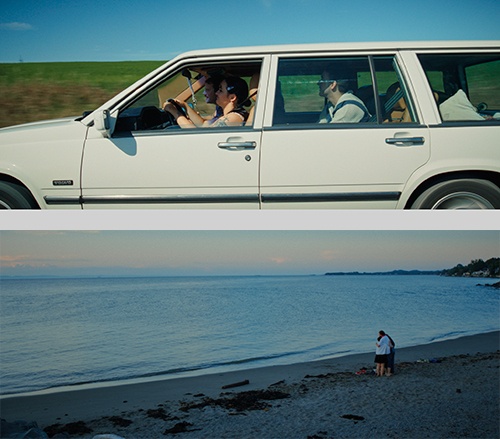
 Photo from Anyway, j’pisse assis courtesy Zak Slattery
Gazing Ahead
Exposures film festival imagines trans cinema beyond the politics of visibility.
On a Wednesday night in early fall, I walked up the steep grey steps and through the wooden doors of the francophone cultural organization Union Française in downtown Montreal. Purple, cream and black posters decorated the entrance. The images—of scattered objects and sprawling human forms lounging, dancing and spilling out of a vintage television screen—formed a bespoke collage referencing trans films, complete with an angel-like figure struck by arrows. It was the opening night of Exposures, one of the world’s few trans film festivals—an exact number is hard to pin down, but best estimations count less than double digits—and billed as the only one of its kind in Canada.
As I entered the festival’s cinq-à-sept launch party, there was a hum of excitement in the room, contrasting a timidity from some festival attendees. A sizeable contingent appeared to have come alone, and were reading in the corner of the Union’s bar and social space, or making polite chit-chat with strangers.
I settled into the bar and met with Charlie Bond, a good-natured PhD student. He’s an old friend of Exposures founder and lead organizer, Iris Pint. Exposures has a growing reputation within Montreal’s queer communities, thanks to its novelty, a grassroots ethos and an ambitious first outing in 2024. This year, the festival had levelled up: Union Française was the most grandiose venue to host an Exposures event thus far, Bond explained. It was a marked transition from the festival’s fledgling beginnings. “Eight years ago I used to go to Iris’ old flat in South London every week,” Bond recounted. “Basically the two of us, plus the odd random love interest, would watch a different queer film once a week,” he remembered. “We’d chainsmoke inside until we could barely see the screen, and we’d also share an oven pizza, even though the oven in Iris’ flat didn’t actually work.” They would broil the top of the pizza and then fry the bottom in a pan, Bond described. As this ritual gained longevity, Iris began referring to it as a queer film night, eventually expanding into a vision for a collective.
“Which I guess is what this is all about,” Bond said, gesticulating into the air. He pointed to the festival bar which was generously stocked with donated drinks from local queer-managed businesses, and at the crowd of fresh festival-goers dotted around the room. In the process, he spotted Pint at the other side, picked up a bouquet he’d bought for them to honour Exposures’ opening night, and strode into the distance. Soon after, we were ushered into the dark festival theatre. Pint was standing ready on the festival stage, in all-black attire adorned with a slim metal chain around their neck. Behind Pint, the purple, black and cream figures glowed on the theatre screen. Once we were settled, Iris welcomed the crowd and introduced us to this year’s theme, Beyond Visibility: A Space of Our Own. They spoke to the audience with a tender, familial warmth, as though addressing a group of close friends, recalling the magic of Exposures 2024. It had served equally as a film festival and community space, where trans people could get together and “just hang out,” they said. Exposures 2025, Pint declared, would provide yet another space for connection. The audience cheered.
That connection is badly needed in our current political climate, as is the concept of moving beyond visibility. Responding to a backdrop of enduring social, political and economic marginalization, trans and queer representation in mainstream media—exemplified by works such as Orange Is the New Black, Pose and more recently Euphoria—have been heralded as progressive milestones in the last fifteen years. However, with the recent surge of hate crimes and acute politicization of trans lives in Canada and beyond, trans and queer communities are forced to reckon with the question of whether, or when, visibility is indeed desirable. As trans lives become increasingly visible in mainstream society, so too does the public policing of trans people in bathrooms, in sports participation and through the grim far-right online phenomenon known as “transvestigation.” Within this context, visibility carries a double burden of heightening the community’s vulnerability to the transphobic violence that accompanies the rising global tide of fascism.
The concept of moving “beyond visibility” is also imbued with layers of meaning addressing the aesthetics of trans cinema. “Trans visibility in cinema has often been about cis legibility—as in, being coherent and understood by cis-gendered people,” Pint told me late in the festival. We were seated on the steps of Union Française, and I sipped on a coffee donated by our favourite neighbourhood spot Café Velours, where Pint and I have convened for coffee since we first met in the summer of 2024. Just days before mine and Iris’ first meeting I had moved across the Atlantic with my Quebecois partner to Montreal. Having found immense pleasure and sense of kinship in queer and trans cultural organizing in England, I naturally sought a similar feeling here. It is astonishing how familiar queer and trans community can feel across continents; I quickly found my footing through Pint who invited me to Exposures events, and later in the wider networks that have made the city feel like home.
The limitation of visibility-as-cis-legibility, Pint explained on the steps, is that the goal of trans visibility does not inherently make space for exploring the complexities, messiness and variability experienced across trans lives. Xavier Dolan’s Laurence Anyways and Tom Hooper’s The Danish Girl came to mind. Both are films from the 2010s with a mainstream reach that traced the contours of a transfeminine woman’s transition. The two films were also met with ambivalence from some trans viewers for providing modest trans representation for their time, but offering little by way of trans experience beyond exploring the potential fraughtness of transition. That is the gap, Pint explained, that Exposures exists to fill.
Refusing visibility as the end-goal for trans cinema formed Exposures’ starting point. The festival’s 2025 program, consisting of eighty-eight films over five days, touched on specific issues, aesthetics, and experiences that are of contemporary interest to the trans community. This spanned earnest explorations of trans life: what it looks like to grow old as a trans person, to play sports professionally, to care for a trans child, or to grow up with a trans parent. The curation also confronted difficult realities familiar to many in the community—the risks of walking down the street, or engaging in grassroots protest, or of coming out to family. At the same time, it made ample space for stylistic explorations, with films that embraced the playfulness of trans experience through the futuristic and the fantastical, and sharp meditations on the sheer absurdity of the world queer and trans people inhabit.
“We wanted to program films that are made ‘in the know,’ that are by and for trans people,” Pint told me. “[Films] that don’t need to explain trans identity, but instead buy into there being shared discourse, shared jokes, vocabulary in the community.” With this shared language, Exposures forms a parallel universe where, as Pint put it, “everyone is trans. For five days you get to experience that utopic vision.”
That vision takes the form of myriad topics and genres. At Exposures 2025, festival-goers could find dark and macabre horror like Willem Koller’s Nest, and soothing, thoughtful child-friendly cartoons including Andrea Russo’s Amygdala. Festival standouts included Eva Grant’s Forest Echoes, a sensitive love story woven amid the struggles of trans Indigenous eco-activism in British Columbia, and Alex Burholt’s gorgeous What to Wear, with its meditations on butch and transmasculine style, layered over close-ups of abstract textured fabrics in motion. Both films presented sincere, intimate depictions of queer and trans life, embodying the DIY spirit that Exposures proudly champions.
The short film program Mondo Transo, meanwhile, provided a smorgasbord of “bad taste” films. Pitched as an homage to John Waters, it honoured the bizarre and the grotesque in trans cinema. The screening opened with Carter Amelia Davis’ mind-boggling, cackle-inducing cartoon Homemade Gatorade, which follows a protagonist enduring a desperate yet seemingly needless overnight drive to drop off gallons of her garish, creamy-looking homemade gatorade to another woman she met on social media. Davis’ piece is a nightmarish and wonderfully artful whirlwind story about being alive and chronically online in 2025. To the audience’s delight, Davis was present at the screening, soaking up the exceptionally positive reception to her film.
Trans filmmakers have long been part of cinema’s landscape—the Wachowskis of The Matrix are emblematic of that legacy. Yet in recent years, independent trans cinema seems to be entering a particularly fertile era. In addition to emerging stylists like Carter Amelia Davis, works such as D. Smith’s Kokomo City and Jane Schoenbrun’s haunting films I Saw the TV Glow and We’re All Going to the World’s Fair have drawn widespread indie acclaim, demonstrating the potential for commercially successful, interior styles of trans and non-binary storytelling that resist traditional narratives.
Vic Gay, a film festival professional who programmed Mondo Transo, spoke with me about the distinct satisfaction of working on an all-trans film programme. “In a lot of film festivals, you’ll [typically] see the films in a few months in theatres because, of course, they’re made by people with a lot of funding,” they explained. In comparison, Exposures has a far more underground, even ephemeral quality. “It’s one of those festivals where you might not see these films again because a lot of them will not get distribution, they are very DIY. [We are] kind of pushing forward, saying look: trans people can make really good art and they should be funded.”
Exposures’ all-trans programming created opportunities for filmmakers and festival attendees to have deeper conversations about the evolving aesthetics and sensibilities of contemporary trans cinema. The opening night short film screening and panel, From Trans Coast to Coast to Coast: New Trans Canadian Cinema, featured films that covered a particularly broad range of subjects, touching on delicate and fraught connections to family, Black and Indigenous kinship and solidarity, and a retelling of Pan and Syrinx of Greek mythology—films that warmed the crowd up for the discussion that followed. With seven up-and-coming filmmakers on the panel, the sold-out theatre was bustling with the feel of friends excitedly and earnestly sharing their art with one another.
The panel included Quebec filmmaker Zak Slattery, presenting their short film, Anyway, j’pisse assis. Set in the Quebec countryside, Slattery’s short follows a trio of friends, two of whom are accompanying the third on a homecoming trip for, presumably, the first time since their transition. Watching the friends against the backdrop of the Quebec countryside, donned in crop tops, tattoos and shaggy haircuts, elicited a feeling that will be familiar to many queer adults who live in cities: “going home” to a small town or village, wearing a suddenly-noticeable personal style that was so obviously honed somewhere else. Much of the film explores the trepidation from the protagonist over this impending visit, and the tender friendship that bounces between the trio during their road trip. The film ends with a scene of the three, driving to a beach at sunset, ripping off their outside clothes and splashing around playfully together in a lake shoreline.
During the post-screening panel, conversation turned to the question of what constitutes the contemporary trans gaze, a topic that popped up throughout the festival. Flipping the question, Slattery offered their thoughts on what making Anyway, j’pisse assis taught them about the cis gaze, and what this might in turn mean for the possibilities of a trans gaze. During editing, Slattery shared, their cis friend suggested including a close-up of top surgery scars during the ending beach scene, when the protagonist is topless. “I get why they said that,” Slattery explained, “but I felt I just didn’t want to,” generating a collective hum of understanding from the audience. “The cis gaze is so often about our bodies,” they continued, “this made me think that the trans gaze could be the opposite. It’s not about what we do with our bodies; it’s about our feelings, who we meet and who we love.” Slattery was met with nods from the other panelists in appreciation of the observation. It seemed to call up Pint’s vision for Exposures as a festival that speaks its own language.
This depth of discussion was made possible by a context where Slattery wasn’t, as they described to me later, the “token trans person at the screening.” Slattery had previously felt lonely in cinema, they explained, as if there weren’t many trans movies or trans people in the industry—especially in Quebec, where they seldom encounter other active trans filmmakers. “Exposures revealed that to be a false narrative,” they reported happily. “It’s just we don’t get the money and therefore our movies are not made, but the interest is clearly there […] and that made me feel really hopeful for the future.”
Peppered between screenings, Exposures hosted events like an erotic performance workshop where two local performance artists guided participants to reflect on our erotic personas, workshopping our sensual body-rolls as we walked and moved up and down the long bar space. The festival arranged, too, a healthcare advocacy and transition access talk led by the Montreal-based Trans Patient Union, one networking and one funding workshop for trans filmmakers, plus an artisan market offering ceramics, art prints, tattoos, portraits and more from local trans artists. These offerings focused on material resource-building among the trans community, but in turn fostered space for genuine connections to form.
The Union bar was at its most electric on Saturday night, during a takeover led by organizers of a Montreal nightlife staple, Queer Karaoke. Usually held at Bar Milton-Parc near McGill University, Queer Karaoke is a joyfully earnest bi-weekly party hosted for queer community to sing, dance and let loose. Careful weaving through the energetic crowd was necessary to reach the extensively scribbled sign-up list. The timidness I sensed in the opening cinq-à-sept had outright dissolved, and excitable singers belted Chappell Roan, Les Cowboys Fringants and 4 Non Blondes until 2 am.
Towards the end of this very pure night of queer joy, I met Eden Stephanson, an Exposures fan from the festival’s first run in 2024. Sitting at the bar together, we got talking about the extreme juxtapositions of joy and violence that trans communities are so often forced to hold at once.
The festival weekend was no exception—that same morning, Exposures’ trans artisan market, previously programmed to start at 11 am, was pushed back by two hours to allow time for festival-goers to attend a counter-protest to an anti-trans rally taking place in the city. Later, sitting under the moonlight on the steps of Union Française after karaoke, Stephanson and I spoke about the strangeness of attending a karaoke party on the same day that a violently anti-trans event was taking place. “I think it’s hard when things are so bad to not constantly be in the place of, ‘we need to look at the suffering and we need to deal with the suffering.’ And that is obviously very important. But in order to survive, in order to live, we have to have time and space to imagine what joy and what community and what connection can feel like,” Stephanson offered. “Because otherwise, why are we fighting?”
Exposures is showcasing the vastness of trans experience and art that mainstream cinematic representation has yet to accommodate. At Exposures, trans cinema is the tender and the bizarre, the scary and the soothing, the viscerally sentimental, the overtly political. It extends beyond telling the “transition story,” and it recognises the pain, beauty, frivolity, complexity and inescapable strangeness of life. The extensive nature of Exposures’ programming made for a slightly overwhelming experience at times, with its packed schedule and short film screenings routinely lasting more than two hours, seldom offering breaks between films. The festival succeeds, however, in refusing to offer one answer to what constitutes trans cinema: it presents only its vast and evolving programme, and the hope of more to come.
Perhaps what separates Exposures most from other film festivals is that you need not be a filmmaker, or even a film fan, to feel at home—the only prerequisite is an affinity with the communities the festival is made by and for.
Exposures does not yet have a secured sustainable funding source to continue year-on-year. On the final Sunday night, as we came to the end of a run sponsored by several one-off grants from Canadian arts funders, I asked Pint about Exposures’ future. “Obviously, we need money to be sustainable as an institution,” they replied. “Ultimately, our sustainability as trans community is realized by us keeping together, processing both trauma and joy together, accepting our differences, and celebrating them.”
Exposures closed by screening six short films honouring the resilience of trans elders. The films showcased trans parents, lovers and community leaders, across the decidedly human experiences of aging, becoming sick, and caring for biological and chosen family. A screening of We’ll Go Down in History, a documentary following a football club for trans and non-binary players in England, incited a strong wave of emotion in the audience during the final night. Filmed over two years, Cameron Richards and Charlie Tidmas’ piece captured the lightheartedness, humility and immense tenacity of TRUK United’s inter-generational community as they cheerfully participated in England’s steadfast sport of choice. Especially touching was the intimacy captured between the elders of the TRUK community and protagonist Emily Waldron—a young, committed TRUK United player and present-day trans advocate who was forced to leave her local school in the face of mounting threats from transphobic bullies. On the pitch during training, or in the kitchen at home, Waldron shared easy laughter and gentle mischief with Lucy Clark, TRUK’s manager and England’s first trans professional football referee that, in its ordinariness, was quietly but deeply moving. From the back of the theatre, I sat in the dark among old and new friends, and we wept together in temporary exhalation. ⁂
Nat Ty is a Montreal-based writer and researcher reflecting on the delights and complexities of queer life. Her writing has featured in Polyester Zine and Mekong Review.