

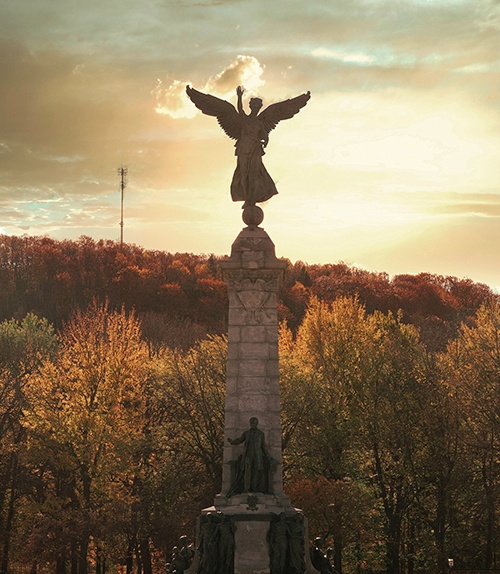
 Photo by Michael Descharles, Unsplash
Allegorical Women
There are plenty of statues where women represent lofty ideals, but not enough depicting women as real people.
If you visit Montreal, you’ll see her—the winged woman who guards the city. High up on a monument on the slopes of the city’s centrepiece, Mont Royal, you’ll catch our civic protectress in the act of stepping into the air. Nicknamed the Goddess of Liberty (officially: La Renommée, or The Fame), the Athenian beauty extends her hand to the people. Below her stands the figure after which the monument is named: a copper statue of a middle-aged man in a dapper nineteenth-century suit, his hand also extended in greeting or blessing. This is Sir George-Étienne Cartier, one of the Fathers of Confederation. The monument was designed by the sculptor George William Hill and inaugurated on September 6, 1919. On the south side of the monument, a bronze woman sits in between a young boy who is holding a globe and a young girl who is reading a book, representing Cartier’s important contributions in education. Below Cartier’s feet stand four other women, two looking up at him, two gazing out at the city. At first glance, you might assume they are Cartier’s relatives or other historical figures. But if you keep looking, then you notice they all wear Grecian robes and that their faces are identical, cast from the same mould. They represent New Brunswick, Nova Scotia, Quebec and Ontario. At the back of the monument are four more women, also with identical features and unseasonable robes, though with differing hairstyles. They represent the provinces that joined Confederation in later years. There are two more female statues, copper matriarchs with their life-sized children, nestled on the other sides. Could they be historical figures? Their clothes are more appropriate to the nineteenth century. No, they represent the concepts of Legislation and Education.
When I was an undergraduate student in Montreal, I used to bike past the monument daily. Sometimes, after classes or work, I’d stretch out on one of its surrounding grassy slopes to read. I was happy to be living in a city with a female face—the face of a flying woman. She reminded me of Sophie Fevvers in Angela Carter’s postmodern novel Nights at the Circus, a six-foot-two, curvaceous, peroxide-blond winged woman (half-woman, half-swan) who, after hatching out of an egg in a turn-of-the-nineteenth-century London brothel, goes on to join the circus and travel to St. Petersburg and across Siberia. These were all things I dreamed about doing myself—I, too, wanted to dye my hair, escape my egg, and travel across Eurasia by train.
But Carter’s precocious avian woman stands in strong contrast to the figure that would become known as Cartier’s Goddess of Liberty. Whereas the Goddess of Liberty could be seen as representing the concept of freedom, the larger-than-life Sophie Fevvers embodies the possibility for women—real, historical women—to move beyond the allegorical figures that falsely represent them. As a novelist, Carter believed her task was to uproot the harmful myths about women’s capabilities by creating a parody of those myths. To do so, she used a mix of what at the time were considered disreputable genres: gothic horror, science fiction, pornography and fairy tale. “I am all for putting new wine in old bottles,” Carter admits in her essay “Notes from the Front Line.” “Especially if the pressure of the new wine makes the old bottles explode,” she writes. Exploding myths and wine bottles, Carter aimed to form a new vocabulary for understanding women’s power. When monstrous Sophie Fevvers first spreads her wings, she believes she’ll herald a “New Age in which no women will be bound down to the ground.” She quickly learns that this is much easier said than done.
After reading Angela Carter underneath the Cartier statue, I began to look at Montreal’s winged monument askance. The Goddess of Liberty was beautiful, solemn and ahistorical. She was a copy of the winged victory that Carter’s novel was parodying. Her serene Grecian face was a copy of a copy, fallen through time. She was accompanied by two lions with huge iron paws and mournful eyes. I ran my hand over one of their faces as I stared up at the Goddess of Liberty, thinking about Carter and Cartier, about fiction and history. About the promised age in which no women would be bound down to the ground.
Why was it that in most of the monuments I’d seen, the male statues represented historical figures and the female ones symbolized concepts? It’s not that we lacked monuments of female figures, I realized; it’s that we lacked monuments of historical women.
One definition of “allegory” historically given by the Oxford English Dictionary has been a “description of a subject under the guise of another subject of aptly suggestive resemblance.” Yet there appears to be no aptly suggestive resemblance between the historical woman’s lot and the concepts her image represents. Reflecting on the omnipresence of this phenomenon in her book Monuments & Maidens, literary critic Marina Warner observes that the reason justice is characterized as a woman in the New York City Hall or the Old Bailey in London isn’t that women were thought to be just. Nor were women considered capable of dispensing justice:
Liberty is not represented as a woman from the colossus in New York to the ubiquitous Marianne, figure of the French Republic, because women were or are free. In the nineteenth century, when so many of these images were made and widely disseminated the opposite was conspicuously the case; indeed the French Republic was one of the last European countries to give its female citizens the vote. Often the recognition of a difference between the symbolic order, inhabited by ideal, allegorical figures, and the actual order, of judges, statesmen, soldiers, philosophers, inventors, depends on the unlikelihood of women practicing the concepts they represent.
What Warner is saying is that the stark difference between the statues of female figures and the concepts they represent isn’t just coincidental but deliberate. It almost seemed that if representing freedom and justice as female, patriarchy could, in a kind of sleight of hand, continue to deny actual women access to justice and freedom. Or, it was precisely because the plan was to continue denying women these rights that they could be easily emptied of subjectivity and abstracted into concepts.
The more I thought about this paradox, the more I noticed it in different art forms. Justice isn’t considered female because women were historically employed as judges, any more than the topless woman in Eugène Delacroix’s depiction of the July Revolution of 1830 was an army recruit. If you’ve forgotten the title of the painting, as I did, just Google “French Revolution Topless” and the image of Liberty Leading the People pops up. The woman walking barefoot and bare-breasted over smoking ruins, holding aloft the tri-coloured flag of the French Revolution, is not a soldier. She depicts the Goddess of Liberty—a concept, not a person. She is also known as Marianne, the national personification of the French Republic.
I recalled Virginia Woolf’s observation of the very similar contradiction between the female figures in literature versus historical women: “Imaginatively she is of the highest importance; practically she is completely insignificant. She pervades poetry from cover to cover; she is all but absent from history.”
Because of this contradiction, allegorical women in bronze or in verse are much more than the allegories they represent. The allegorical woman is always already multiple. She represents both freedom and the unfree. As Angus Fletcher in Allegory: The Theory of a Symbolic Mode puts it, “allegories are far less often the dull systems that they are reputed to be than they are symbolic power struggles.” That was how I began to view the female statues I encountered in museums or in public squares—as power struggles.
Although created as containers for fixed meanings, the allegorical women crowding Cartier’s feet are, in fact, imperfect vessels. They exist in the world as ahistorical symbols of virtue, and in the case of the provinces, symbols of stolen land. If they were perfect signifiers, why was I standing beneath the statue wondering what the province of Saskatchewan had in common with this lady in a bedsheet? Oh, what nice shoulders that symbolic power struggle has, I thought, staring up at the impassive bronze goddess representing Education.
Standing beneath the Cartier monument, I wondered if there were any statue clusters in the city, or the country, or perhaps in the world, where the male figures represented concepts and the female figures historical women. I could find monuments of historical women and historical men, or of allegorical figures representing soldiers (the wounded soldier on Omaha Beach, France) and immigrants (the Angels Unawares bronze sculpture at St. Peter’s Square in the Vatican).I could find historical men and allegorical women, like the Cartier monument, but never allegorical men and historical women together. So gender inequality exists even between statues.
Imagine a statue of women’s rights activist Nellie Letitia McClung surrounded by three half-naked male virtues in togas representing Courage, Perseverance and Wit. Like many men historicized through monuments, McClung had serious faults and troubling beliefs. Along with other members of the Women’s Christian Temperance Union, she was an advocate for the racist and ableist eugenics movement in Alberta, viewed women as “morally superior” to men, and did not feel that traditional gender roles should be changed. Yet she did help women gain the right to vote in Alberta and Manitoba in 1916. And she certainly could have used the help of Courage and Perseverance when, in 1928, she battled with the Supreme Court of Canada over the rights of women to be considered persons.
There isn’t much data to be found on the ratioof male-versus-female monuments, nor is there data on the ratio of monuments of allegorical women compared to monuments of historical women in Canada. But in the United States something was designed for this particular purpose. At theMonument Lab, based in Philadelphia, there exists a database created to track the nature, prevalence and economic backing of monuments in the United States from the “monument mania” of the mid- to-late nineteenth century to the early twentieth century. This was a time when Reconstruction and a desperate attempt to make sense of the horrors of the Civil War led to a degree of American self-aggrandizement and identity-building not seen before. The statues and memorials commemorating military and political leaders, and surrounding these figures with allegorical women to represent their virtues, served as propaganda tools for reconciling a divided nation with a supposedly unifying narrative.
But I believe that another reason allegorical figures proliferated in the nineteenth century is because of the emerging debates surrounding women’s social roles and an increasing cultural anxiety about women’s intellectual and creative capacities, as women attained more prominent public positions outside the Church. It simply became more difficult to unquestionably assume the inferiority of women’s intellect compared to that of men when reading Jane Austen, or when listening to the speeches of Mary Wollstonecraft or abolitionist Sojourner Truth.
New branding was needed to maintain male intellectual dominance, and to separate male writers from what Nathaniel Hawthorne in 1855 called the “damned mob of scribbling women.”Hawthorne made this comment when complaining to his publisher that women writers had taken over the literary scene and were weakening his chances at publication and of reaching a larger audience. “America is now wholly given over to a damned mob of scribbling women, and I should have no chance of success,” he lamented. It was these kinds of fears that led to the concept of genius being remodelled as an inherently (white) male capacity during this time, and a tool to exclude women from serious creative and intellectual activity. Turn a woman into a monument to Freedom or Progress and you erase her individuality and reduce her to a vessel.
During this intense period of monument building, statues of primarily elite, Anglo-Saxon men (and their horses) filled—and continue to crowd—the country’s public squares. According to a 2023 study conducted by the Monument Lab titled the National Monument Audit, there are around three hundred statues honouring real women in the United States compared to about five thousand honouring real men in the country. That means only 6 percent of American monuments feature real women as their subjects.
Joan of Arc is the most represented woman in statues in the United States, studies show, which is surprising because she wasn’t American. In fact, America wasn’t even a country when she existed, but just a twinkle in the eye of the imperialist project. Joan was born and lived her short life in France, where, at the age of nineteen, charged with heresy, witchcraft, and dressing like a man, she was burned at the stake. But perhaps Joan of Arc is so celebrated within the public square, and therefore public imagination, because though she’s a historical woman, she comes closest to an allegory—a representation of bravery and defiance, of the power of faith. In this sense, the historical Joan has been eclipsed by her mythic persona.
As far as American-born representatives go, Harriet Tubman is the second-most honoured woman in the United States, followed by Sacagawea, Rosa Parks, and Sojourner Truth. Yet at the time of the Monument Lab survey in 2023, there were twenty-two sculptures of mermaids versus the twenty-one honouring Tubman.
To be clear, this isn’t an argument for fewer mermaids—my favourite mythical creature since the age of five—it’s an argument for more monuments of and for women.
The year I discovered Angela Carter, I visited New York City for the first time.I drove down from Montreal with a group of friends from high school. There were four of us, all in our early twenties, all from the mountains of British Columbia. This was the first time we’d visited such a huge city, never mind such a famous one, whose streets seemed strangely familiar to us because of all the films and TV shows we’d consumed as adolescents.
For four girls from a rural community in Western Canada, New York City was as mythical as Rome or Florence. But instead of a marker of the ancient world, New York with its noise and verticality was a gleaming monument to progress, money and ambition. While we wandered, dazed, through Central Park, a man driving a horse and carriage yelled out at us: “Hey, Sex and the City, want a ride?” In that moment, we couldn’t tell if we were strolling through a movie set or if this was real life.
We spent the day wandering among the city’s museums and monuments. Not far from the New York Public Library, Gertrude Stein’s bronze likeness sat Buddha-like in contemplation. We visited the Whitney Museum, which, some years earlier, had hosted a retrospective of another monumental woman, the Cuban American artist Ana Mendieta. In her 1970s Silueta Series, Mendieta created female silhouettes in nature—in mud, sand and grass—with natural materials including tree branches, moss, sand, fire, gunpowder, and on occasion, animal hearts. These Siluetas, which I only discovered years later, refused simple allegory. They redefined the nude, from artist’s muse to a powerful and creaturely force of nature, an attempt to access what Mendieta called an “omnipresent female force.”
Mendieta often used her own body in these works. In “Tree Of Life” the artist stands against an enormous trunk, naked and coated in mud with arms overhead. In “Image From Yagul” she lies nude in a Zapotec tomb with white flowers strewn over her body. The flowers almost appear to be growing through her skin. In “Ocean Bird (Washup),” she’s covered in feathers and floating on her back in shallow waves, a liminal figure tossed between land and sea.
In photograph and film documentation of these performances, her body is both powerful and prone, both present and disappeared, obscured by flowers and feathers. An act of reclamation, concurrently half-hidden. Her absent present body might also signal the position of women artists, and especially women artists of colour, in the late twentieth century: only just shifting into view.
Upon her return to her birth-country of Cuba in 1981, Mendieta’s Siluetas evolved into her Esculturas Rupestres or Rupestrian Sculptures: a series of abstract figures incised in clay and cut into limestone rock that she named after Goddesses from the Taíno and Ciboney Indigenous cultures. She’d hoped that these monuments would be discovered by future visitors. Though most of these sculptures have now been destroyed by erosion, their images survive in Mendieta’s films and photographs.
How different these earthen sculptures were from other more traditional monuments, how porous and vulnerable to their environment. In the artist’s eyes, a dialogue between landscape and the female body. In a 1981 artist statement, Mendieta writes: “My art is the way I re-establish the bonds that unite me to the universe. It is a return to the maternal source. Through my earth/body sculptures, I become one with the earth.”
But even a defiant and path-breaking artist like Ana Mendieta couldn’t escape the misogynist traps of the art world.
In the early hours of September 8, 1985, Mendieta fell from the thirty-fourth-floor Manhattan apartment she shared with Carl Andre, her artist husband. Neighbours had heard the couple fighting. In court, a doorman testified that he heard a woman screaming “no” several times around 5:30 am, and then the thud of her body as it hit the roof of the all-night delicatessen below. She hit the surface so hard that her head left an imprint.
In his 911 call, Andre is quoted saying: “My wife is an artist and I am an artist and we had a quarrel about the fact that I was more, eh, exposed to the public than she was and she went to the bedroom and I went after her and she went out of the window.”
Had she been pushed or thrown? Had it been an accident? Andre later claimed to remember nothing of the events leading up to her death.
Recently, on a trip to New York, I sat in a dark room at the MoMA and watched a series of Mendieta’s films. In one, a woman’s outline, carved in the earth, blazes up in flames. A brief, dazzling monument.
How different this burning figure was to the allegorical women at Cartier’s feet in Montreal, or the stone women at the entrance of the New York Public Library down the road, or the giant bronze woman on her island in the harbour. Earlier that day, on the Staten Island ferry, I’d raised my camera to meet her severe, blank stare. Yes, Lady Liberty was another female figure who was not representing her own freedom. I thought about how Mendieta’s monuments to women’s power pushed back against the pristine conceptual woman who lives forever, a conveniently empty vessel to serve a patriarchal system. Mendieta’s Siluetas channeled archetypal forces, but they were also the raw imprints of a body that lived and moved: the flesh and blood artist whose story was cut short.
After Ana Mendieta’s death, Carl Andre was arrested but subsequently acquitted of all charges. Despite being dubbed the “O. J. of the Art World,”Andre would go on to enjoy a celebrated career, his minimalist sculptures monumentalized by galleries across Europe and North America, though his exhibitions would often draw protests, particularly from feminist artists. Mendieta’s career, on the other hand, would be frozen in time.
Andre’s lawyers used Mendieta’s artwork—her themes of violence against women and the natural materials she used, like blood and fire—to evoke a tortured artist and troubled person who would clearly take her own life. They brought up her blood alcohol level on the night of her death to discredit her. Andre’s lawyers cited the fact that alcohol consumption can increase suicidal tendencies. A counterpoint might have been that Mendieta’s smaller stature and intoxication made her more physically vulnerable. His blood alcohol level was not tested that evening. It was never concurrently cited that alcohol consumption can increase anger and aggression. The case against him was built on an alleged argument over who had more status in the art world and he refused to testify at his own trial.
But the portrayal of Mendieta as a reckless, tortured, suicidal artist didn’t sit right with the people who knew her. They described the artist as passionate and ambitious with a voracious hunger for life. Her consistent use of natural materials can be seen as life affirming. A friend of Mendieta’s recalls a conversation only months before the artist’s death: “She told me that she was making new work and that she was going to give up drinking and smoking because women artists did not get recognition until they were old. She said that she wanted to live long enough to savour it.” ⁂
Excerpted and adapted from Women Among Monuments (Dundurn, 2026). Used with permission from the publisher.Kasia Van Schaik is the author of the Giller Prize-nominated story collection We Have Never Lived on Earth and the forthcoming book of memoir and cultural criticism Women Among Monuments. She holds a PhD in literature from McGill University and is an assistant professor of English and the co-director of Creative Writing at the University of New Brunswick in Fredericton, Wolastoqiyik territory.