
Letter from the Editor
Introducing issue 98.
“Pick a decade and I got names you’ve never heard of,” writes Hanif Abdurraqib in There’s Always This Year. “Guys who hooped because they wanted to be respected on the streets they loved.” Abdurraqib’s 2024 book is about growing up in Ohio at the same time as LeBron James, witnessing the ascension of a legend. Abdurraqib reminds us that for every superstar like LeBron, though, there are names and names that only resonate in some boroughs, or on some blocks. And that the spirit of a sport like basketball—the way it can take over the emotional climate of a city and pull non-believers into its orbit—depends on all those names, the internationally renowned and the locally cherished.
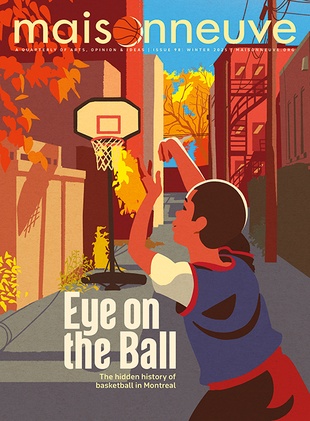
In our Winter Issue cover story, sports writer Oren Weisfeld picks several decades, and highlights names that you might know and some you probably don’t. He tells the story of how Montreal became a basketball town, beginning with Montreal North’s Luguentz Dort bringing home the NBA championship trophy this past summer, and working backwards. In a province—and country—where white-dominated hockey has long ruled supreme, Montreal basketball attracted players from under-resourced and over-policed neighbourhoods. Lacking adequate provincial support, those players built up their own infrastructure instead, re-making the city in their image.
The second feature in this issue pivots from the basketball court to the equally lively community space of the campus radio station. Sonia Persaud reports on the increased financial scrutiny facing these stations amidst a decline in radio’s dominance, and the kinds of strategies they are adopting for survival. Edna Wan and Daniel Banoub, meanwhile, take two very different approaches to culinary cultures in respective essays; the former, an inquiry into the practice of underground food sales on Facebook Marketplace; the latter, a critique of how Newfoundland chef Jeremy Charles has marketed the province’s rural authenticity. Both writers drive home the importance of seeing food in context, that what we eat contains markers of who we are and where we belong.
Belonging is a tricky aim, often conditional and exclusive, a feeling that depends on playing the game the right way. The stories in this issue ask questions about what it means to advocate for the place you call home, or to become representative of it. In his cover story, Weisfeld spotlights people who decided to play the game on their terms—players who invested in their communities, brought kids together, and established something long-lasting, whether or not the province was paying attention. Championships are built over decades, as this story details, and support systems are more important than any one person’s raw talent. To lift off the ground and into the history books is a collective act.
Rosie Long Decter