

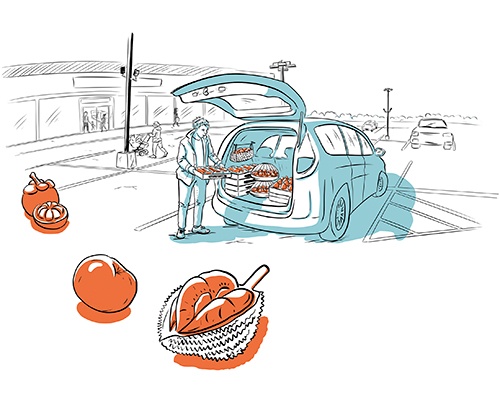
 Illustration by Mélika Bazin
Forbidden Fruit
Not just a source for second-hand tables, Facebook Marketplace also hosts a vibrant underground food economy.
The first time my dad brought me to meet a stranger in an empty parking lot, I thought we were committing a crime. I was nineteen. It was a bright, summery afternoon when we found ourselves idling in the middle of an open strip mall, indiscreetly waiting for our accomplice. My dad was busy on WhatsApp, messaging our associate. I was trying not to look at the security guard, whose narrowed eyes were beginning to warm the surface of my skin. Soon, a black minivan arrived and parked a couple rows across from us. A middle-aged woman stepped out and looked around, before waving us over. We tried to make small talk as she opened her trunk to hand us our goods. My dad passed her $20 in cash. After hurried goodbyes, we scurried quickly back to our car. The deal was done.
I kept the box safely in my lap on our way home, gently lifting open one corner. A faint scent escaped—earthy, fruity and floral. When my dad asked me how they looked, I opened the box and proudly showed him our precious loot: three bags of mangosteens, a tart, lychee-like tropical fruit, flown directly from Vietnam. For the sin of “eating global” rather than “eating local,” I admit the costly transport of fruit by airfreight is a luxury and an imprudence. But it’s driven by the same impulse that makes me constitutionally unable to show very much restraint when it comes to eating and living deliciously. I use my fingers to break the shell of a mangosteen open before we even get home, savouring each bite of snow-white flesh.
Buying food from strangers online is by many accounts a bad idea, but it’s never been so easy. A cursory search on sales platforms like Facebook Marketplace, Kijiji and Craigslist reveals pages and pages of homemade foods for sale: jars of kimchi, vegetarian tiffin lunches, crusty loaves of sourdough, Jamaican oxtail stew. Take a look and you’ll see that technological advancements have not only made it easier to sell food online but that there’s a substantive market for it, too.
Keep scrolling and you’ll find—thanks to Joe Rogan, Robert F. Kennedy Jr. and the growing popularity of the carnivore diet—even more dubious, overtly illicit options like raw milk by the gallon. And if unpasteurised milk isn’t quite what you’re after, there’s also breast milk (which is sold not only to mothers struggling with delayed milk supply, but also to body builders, who prize the substance under the ill-informed belief that its consumption can enhance muscle growth). Perhaps it goes without saying, but with regards to the bottomless morass of the internet, search for anything and it can be yours, as long as you’re willing to go get it.
In Markham, a predominantly East Asian suburb of Toronto, the buying and selling of food on the internet has become something of an open secret. On Markham’s Reddit page there are puzzled users detailing suspicious sightings of people waiting in long lines behind nondescript cars in parking lots. Wary neighbours describe seeing expensive cars pulling up to quiet suburban homes, and the strangers who leave soon after with mysterious boxes in hand.
Over the years, I’ve joined countless Facebook groups dedicated to the buying and selling of food. Their differences are in size, rather than kind. The largest group I’m in includes around 12,000 members, and the smallest around 1,500—not an insignificant group of buyers investing in the same informal marketplace, establishing their own web of consumption on the outskirts of the formal economy.
If you narrow your Marketplace search to a particular neighbourhood, you can get a good sense of the people who live there and how and what they eat. In the rural outskirts of Toronto, you’ll find more produce options, small-scale farmers selling crates of Ontario peaches in late summer, heirloom tomatoes, bushels of corn. In Markham, more Chinese food; North York, Korean and Persian; Brampton, more South Asian fare. During the month of Ramadan, I notice more sellers in Scarborough and Mississauga offering party platters catering to large gatherings breaking a long day’s fast. In the heart of downtown Toronto, there are more individually portioned meals than in the suburbs. But I try not to click on those because it’s depressing to think about how many young people grow up to learn that eating primarily as a communal experience can devolve quite quickly into a lonely, individualized routine. Given the size and diversity of the Greater Toronto Area (GTA), the city is an exemplary model of this underground network, though hardly an exception. From Vancouver to Fredericton, similar markets exist, especially in urban regions with dense immigrant populations.
Most posts are accompanied by lengthy, overripe descriptions, punctuated with a liberal use of emojis. In a post for homemade pig-stomach white-pepper soup, for instance, a seller begins a long text written in Chinese by claiming to have “partnered with a Hong Kong chef who had previously worked at a Michelin-starred restaurant in the creation of this meal.” She goes on to describe the inclement weather we’ve been having, and how the soup is perfect for dispelling dampness and fighting off colds. “It’s delicious, rich, though never greasy.” She apologizes for the haphazard photographs she’s included. “I couldn’t resist eating it before it was even served." In a post for imported Hawaiian papayas, the same seller describes the fruit as, "sweet and juicy, honeyed relish and firm flesh.” It’s difficult to convey the cadence in translation, but her description has a delightfully poetic quality, achieving a rhythmic flow through its parallel structure. Her caption announces that these papayas are superior because they are harvested only when they’ve matured on the vine to ensure optimal flavour and texture.
In another post for homemade Swiss roll cakes, a seller discloses precisely how many grams of premium hazelnut cream she’s used, along with a belaboured description of her work (she roasts and purées chestnuts by hand). Her use of costly, high-quality ingredients and time-intensive labour, is “an effort” she claims, but ultimately “worth it.” Her cakes have garnered a small, devoted following. From what I’ve noticed in the Facebook groups, she is one of few who mention having a Food Handler Certificate, but she already has my confidence from pure description alone. The process of selecting a seller mirrors the process of eating itself: choosing what foods to eat and when based on intuition.
On a transactional platform like Marketplace, the purchasing of food is analogous to a peer-review system. Customers can (both fairly and unfairly) rate the object and service they receive. Included in each post is a description of the seller’s delivery and pickup process. In the groups I’m in, sellers post on Facebook and ask you to place your orders on WhatsApp. In many ways, buying food online is more time-consuming than a trip to the grocery store. After all, Marketplace is rarely a one-stop shop. Most of us turn to it for specialty items or homemade dishes we can’t easily find at our grocery stores. It supplements the formal economy but in no way replaces it.
One seller I spoke to, who is using the pseudonym Ellen due to privacy concerns regarding the practice, is a student at OCAD University. Earlier this year, Ellen began selling Korean lunchboxes: neat containers of rice, protein, vegetables and side dishes as a way to supplement her income. “A lot of my classmates often talked about how much they missed home-cooked meals,” she told me. “Especially those far from family or living on tight budgets. That’s what inspired me to start cooking for others.” She speaks about food with much of the same language she uses to describe art. Cooking, she explained, is another medium. There’s precision in her approach to both, but also play.
As a full-time student and server at her parents’ Korean restaurant, Ellen couldn’t take on another job with fixed hours. Operating outside the formal economy, she described, offers a flexibility traditional work can’t. “I moved into my first apartment this year,” she said. “It’s right across from OCAD. Just steps away. So it’s amazing for getting to class and going to the studio, but also for selling food. I can just drop meals off between classes or have people pick them up. The location makes it so easy.”
Ellen sources many of her ingredients from her parents’ restaurant, drawing on their inventory. “My parents think it’s funny that I’m doing this,” she told me. “They keep joking that I’m competing with them, but I think they’re also happy.” In some ways, her lunchbox business continues the work of her parents, who also built their lives in Canada through food. “I meet all kinds of people, which is one of my favourite parts,” she added. “But it’s true that most of my buyers are my classmates and other students, because I try to keep my meals budget friendly. For the community.”
Across Canada, online food selling has become an invaluable tool, supporting a broad spectrum of communities by meeting a combination of cultural and economic needs outside bureaucratic regulatory frameworks. In Nunavut, where the immigrant population is significantly smaller, selling food on Facebook has similarly grown in popularity, serving as a lifeline in a different context. According to the Nuluaq Project, 70 percent of Inuit adults live in food-insecure households, a rate six times higher than the national average. In this context, Facebook groups dedicated to the buying and selling of foods such as caribou, Arctic char and narwhal have emerged as vital platforms, offering Inuit people improved access to traditional foods and greater autonomy over local food systems.
But technology does not always deepen our connection to food. As a result of the demands for health and convenience, more Canadians than ever before want the freedom of thinking less about their groceries, and working less to get them. It is a minority market, though a growing one. Meal kit delivery services in Canada are slowly gaining ground, for instance. By presenting grocery shopping and cooking as a frustrating, if necessary, burden, companies such as HelloFresh, Blue Apron and Chefs Plate promise to liberate consumers from planning, shopping and preparing our meals. They deliver perfectly portioned plastic sachets of ingredients to make dishes like “Jamaican-Inspired Chicken with Black Beans,” “Hawaiian-Style Coconut Tempura Shrimp,” and “Iranian-Inspired Butternut Squash Stew” right to your door.
Unlike the meals sold on Marketplace, the emphasis on “style” and “inspiration” in these dishes is telling. Bereft of the authentic encounters enabled through structural circumstances that actually give rise to such fusions, these meals are less meaningful foodways than pre-packaged gestures to diversity. Perhaps one day they’ll design a meal kit called “Chinese-Style Pork White-Pepper Soup,” substituting offal for a more palatable type of meat.
If not meal kits, it’s the growing market for ready-to-eat meal delivery services. Or the proliferation of grocery delivery services like Instacart and Amazon Fresh, and the increasing corporate experimentation with grocery stores serviced entirely by robots. The list goes on. It’s hard not to sound puritanical when it comes to these aspects of modernity, but these supposed innovations are blunting instruments that not only make us lonely eaters, but worse, more alienated cooks. Exacerbating the atrophy of competence at the very fundamentals of survival, these services also obscure the deep, inextricable connections our food has with the people who labour for it and the land from which it’s harvested. It’s easy to forget the long journey our food has travelled and the many hands it’s passed through when it arrives already portioned and packaged at our doors.
The dizzying speed with which new technologies have permeated every aspect of our lives often feels like the natural tide of progress. Yet beneath this veneer of modernization lies the triumph of corporate engineering, orchestrated by a handful of powerful executives. They seem indifferent to how the march towards automation is profoundly transforming interactions with our cities and each other. In contrast, the foods I’ve bought through Facebook have led me to new people, dishes and neighbourhoods, showing how each is woven into the other.
The foods on Facebook are more than evidence of our increasingly globalized world and the transformation of food culture developing in real time. Shaped by broader migration patterns and internet connectivity, they form a digital archive of the innovative ways that people in the GTA are carving space for themselves outside of the regulated economy. These vendors manage every facet of their businesses, from sourcing to coordinating order fulfillment, largely as one-person enterprises. Either in addition to their day jobs or as their primary vocation, it’s arduous work that requires a delicately choreographed operation.
In Canada, the sale of food is strictly regulated. Yet the laws against the distribution of food are as obscure as they are labyrinthine, varying from province to province, and between municipalities. Home-based food vendors in Ontario must abide by food and safety regulations which prescribe different permits and rules depending not only on the types of food being sold, but also how it’s managed, treated and stored.
While you don’t need a permit to sell food online specifically, you are required to obtain a Food Handler Certificate and have your premises inspected by local health officials. The frequency of inspections depends on the scale of your operation and risk assessment, though information on exactly how this is determined is difficult to source, meaning sellers are somewhat left in the dark. Importing foods from outside the country also requires licensing, not to mention hefty custom fees. Navigating legalese is its own herculean undertaking, exacerbating the logistical difficulties of managing an independent home business.
There’s a gap in enforcement that enables many sellers to operate under the radar. Over the past decade, the growing number of home-based food vendors has posed a significant challenge for health officials to regulate. Sellers are obligated to obtain the proper certifications and inspection permits. Although inspections are free, not everyone follows the legal process. Non-compliance stems from a range of factors. Some vendors are immigrants who face language barriers and may be unfamiliar with local regulations. Registering the businesses can also be seen as too costly given their small scale, and too tedious. In Ontario, provincial business registration fees range from $60 to $300. Additional municipal requirements in Markham include proof-of-work status, articles of incorporation, business name registration, a valid HST number from Canada Revenue, insurance and health inspection reports. Others engage in the practice almost as a form of protest—while they might be aware of certain laws, they disagree with how they are imposed on citizens, and have made the choice not to comply. There may be still more reasons for non-compliance that vendors are reluctant to articulate, given the underground nature of the work.
Sellers can have years of food-handling experience from their home countries, but regulations in Ontario might be more complex than those they’re accustomed to, according to one source. Furthermore, the province’s 2021 exemptions for selling what it calls low-risk “cottage foods” like breads, cakes, pickles and jams have also contributed to the bureaucratic confusion, at least on social media platforms like Reddit. Public health units rely heavily on tips from the public to report unlicensed operations, making it virtually impossible for officials to grasp the full scale and scope of this underground industry. Buyers, meanwhile, face health risks such as exposure to foods made in unsanitary conditions, improper food handling and storage, or unclear ingredient and allergen information.
Individual unauthorized food vendors can face a range of penalties, including immediate fines typically between $250 and $1,000 per offence, compliance orders, or closure for serious hazards like pest infestations. Repeat or high-risk violations can lead to prosecution, with fines up to $5,000 and, in rare cases, jail time. Health officials are working to better educate the public on legal requirements and procedures. They’re also urging consumers to ask sellers whether they’ve been inspected or if the health unit is aware of their operation.
Beyond potential health risks, many small restaurant owners have accused online food sellers of undercutting their businesses. These restaurateurs, who have invested tens of thousands of dollars to legally license their commercial kitchens, attribute a decline in their sales to the growth of this unregulated online food economy. Many have resorted to reporting these sellers to local health officials, calling for more stringent government oversight. Pavan Kumar Moodalkatte, a South Asian restaurant owner in Fredericton for example, told CBC News that he’s reported online sellers to health officials six times over a sixteen-month period. If these sellers on social media continue unchecked, Moodalkatte says, “[I’ll] have no other option but to shut down.”
Instead of relying on the public to report home-based food sellers, the government could draft regulations specific to these businesses. This could include adapting certain rules—such as requirements for separate handwashing sinks, zoning and licensing criteria, or setting limits on the number of meals based on kitchen capacity—making it easier for home cooks to operate legally while still ensuring food safety. York Region already offers a centralized webpage outlining the permits and certifications required to run a home-based food business. The site includes resources in multiple languages, reflecting the diverse demographic makeup of the region’s informal food economy. Food handling courses and exams are also available in several languages—indicating some efforts to address the language barriers contributing to non-compliance.
Last year, I came across a 2010 Toronto Star article about a man who had driven from Virginia to Toronto three times in a single summer in pursuit of a prized variety of Pakistani mango. The two most popular varieties, the chaunsa and the anwar ratol, Pakistanis contend, are unlike any other: sweeter, more concentrated, and they have a buttery, custard-like texture in comparison to the Indian alphonso. The anwar ratol are exclusively available from May to June and their limited growing season only adds to the fervour, inspiring something of a religious devotion among their disciples.
In my quest for these life-changing mangoes, I took to Marketplace, where I found half a dozen postings: “The KING is here—Chaunsa just landed! Fresh from Pakistan, received less than 24 hours ago.” “ Look what just landed—Anwar Ratol mangoes straight from Pakistan! If you know, you KNOW […] These are the sweetest, juiciest mangoes you’ll taste all summer. ” I began messaging. One seller described a precarious pricing system that was determined by the shipment’s date of arrival. For a box of five-to-six mangoes, prices began at $32, decreased to $30 after two days, $25 after three or four, and went down to $20 after six. Within hours, a woman named Saniya Wasim messaged me back, telling me to place my order with her on WhatsApp.
I embarked on my journey the next afternoon. It had rained earlier that morning, and a drowsy mist clung to the air. After two hours sitting in traffic, I arrived at my dealer’s address in Brampton. As I approached her house, a woman sitting on the second-floor balcony looked down at me and asked who I was looking for. Before I could pull out my phone to double check the address, she said: “Oh! You’re here for mangoes? Just knock on that door over there.”
A young man answered. After confirming I was there for mangoes, he asked how many boxes I’d ordered. I said two, but he brought me three. He opened each box, revealing rows of golden-green gems. He showed me each mango, inspecting them for blemishes. We spoke about the fruit and he advised me on how to tell optimal ripeness based on colour and texture. The man I’d spoken to, I later learned, was Wasim’s partner. A few weeks later, I called Wasim during her lunch break to learn more about the trade. She explained that this was her second year importing for distribution. She described the process like this: from late June to mid-August, she imports around thirty boxes of mangoes each day. Sometimes, the shipment is delivered to her house, but other times, she and her partner have to drive to the customs dock at Pearson airport and wait many hours to collect their shipment. Within a day or two, their entire stock is sold.
When I asked Wasim how she got into the mango importing business, she showed me her mango tattoo below her elbow. She had grown up between Canada and Pakistan, with a mango tree in her backyard. Two years ago, she was working a government job that drained her. It was the kind of work that made her dread waking up each day. She described feeling alienated, “like a robot,” toiling in a stifling office environment in service of someone else instead of herself and her community.
During this time, Wasim launched a hot sauce business with the help of a family friend in marketing. She promoted her sauces on Marketplace and TikTok: fiery blends of scotch bonnets, habaneros, pineapples, persimmons and the prized chaunsa mango. While most sellers just post photos of mangoes, she features in many of her posts, smiling and posing with the fruit. Her presence as a young woman in the largely male-dominated world of Pakistani mango imports has become part of her brand. “As a younger woman,” she explains, “sometimes I’ll get older Pakistani men trying to undermine me, lowballing me, but I realized that I can also use that to my advantage.” Her visibility attracts customers intrigued by her confidence, and she’s learned to meet condescension with charm.
Wasim eventually left her government job to take greater control of her business. She found a supplier for her peppers and persimmons through Marketplace, and a dealer for mangoes who imports from Pakistan. The idea of selling mangoes arose when she realised how many she needed for her sauces. “I wanted to express my love for mangoes by sharing them,” says Wasim. Mango connoisseurs insist the best fruit is handpicked when ripe, yet most farms harvest them underripe to account for maturation during transit and storage. Managing the fickle timing of a mango’s harvest is part of what distinguishes the ordinary from the outstanding.
Both Wasim and her partner have full-time jobs. She now works a nine-to-five at an immigration and refugee law firm. “As an immigrant myself,” she says, “I have a lot of empathy and feel a real connection to everyone in this line of work. It’s really a privilege to be able to help others.” Balancing two jobs isn’t easy, but Wasim enjoys the people she’s met in the process, a broader community she’s created through the sharing of good food. “Eating well can be a deeply transformative experience,” she tells me. “Like a feeling of happiness and euphoria” that intensifies when shared. Repeat customers and word-of-mouth referrals are golden, part of the reason she believes she’s been so successful. Wasim’s had customers drive to Brampton all the way from Kitchener and Niagara Falls. Others have purchased fifteen boxes at a time.
My quest for the ever-elusive chaunsa mango is now another item I can add to my growing roster. Over the years, I’ve bought many foods from strangers I met online, though they haven’t always been good. It’s a game, largely, and along the way, I’ve come to find the troublesome entropy of scouring the internet, contacting strangers, placing orders, and driving from neighbourhood to neighbourhood a great source of enjoyment. When I think about the people who make the twelve-hour trek from America to Canada for Pakistani mangoes, I know it’s for the fruit itself. But it must also be, I think, the pleasure of the search, the thrill of discovery, exploring new places, and the unexpected conversations and friendships that blossom along the way.
For those of us who like to eat, Toronto is an especially good place to do it. It’s a diverse, multicultural metropolis offering nearly every cuisine in the world. New restaurants seem to open daily, tucked under bedazzling glass high-rises or nestled along busy downtown streets. But there’s another version of Toronto’s food culture that is flourishing in the margins, found in ever-more creative uses of the internet, eked out by the everyday people who live, eat, and make up this city—where food culture thrives in suburban strip malls, your neighbour’s kitchen, and in clandestine meetings in parking lots. ⁂
Edna Wan is a writer and online food community enthusiast from Hong Kong.